Wednesday, November 15, 2006

Toys For Tots refuses Jesus... well, a Jesus doll


A news report in my daily newspaper but that appears elsewhere in fuller detail tells that the Marines Reserve's program Toys For Tots has turned down the offer for 4000 talking Jesus dolls. The verses Jesus spouts are listed at the one2believe website. You can actually hear the recording in mp3 version there.

Toys For Tots wants to be sensitive to those who might receive the gift and are not Christian. The director of business development, Michael La Roe is quoted in the article as saying, " "I believe as a churchgoing person, anyone can benefit from hearing the words of the Bible."

But benefit to what end is what I would ask? There are some words of the Bible that would fall under Natural Law... certainly many proverbs fall under this category. But the doll only gives one of those kind of quotes, and that is rooted in the character of the community of God's people ("Love your neighbor as yourself). Instead the other verses are all about the unique position Jesus plays in the life of faith: his death, belief in Jesus, the kingdom, etc.

These verses are explicitly evangelistic in nature. But the evangelism being foisted upon the receivers of this gift is a guerilla evangelism, a surprise attack of the gospel. For many there will be no way to take this gift as anything but propaganda. This gift is not evangelism plain and simple.

The Bible gives many stories of evangelism and none would fit this. Prime in my thinking is the story of Philip and the Ethiopian eunnuch. Phillip didn't just throw the Scripture at the official, but took the time to explain what the eunnuch was reading... that led to baptism, and a relationship... a grafting of someone into the body.

We let people off the hook if we continue to let them think that evangelism is solely about hearing the Bible and then making the hearer decide what to do based on that. And given that Toys For Tots is a program for the poor, we allow folks to think that ministry can be done without having to actually deal with the poor. We can just send talking Jesus dolls instead. And while I am hesitant to say it, I fear the true motivation of one2believe will be accomplished even with the rebuff of Toys For Tots. Dolls will be sold in greater number now. People will buy them just to show their support and then give them away at Christmas to some unsuspecting child, who by the way might not need the doll (i.e. the boy or girl is a Christian already). Anyway... the question here is what kind of people are we forming when we undertake such an action.

Evangelism is both simple and complicated. Simple, in that, evangelism is about speaking God's good news in Christ Jesus; complicated though, because evangelism requires relationship and risk. But it is precisely this risk for which we are freed in the waters of baptism. We are free to risk and open ourselves to those in need, so that they might experience God's grace. We are freed not only to send goods (of various quality) to the poor but actually to identify with the poor. Somehow sending 4000 Jesus dolls doesn't quite seem to do that.

Peace.

Tuesday, November 14, 2006

Fallen Powers and God's Providence

Most of the reference to the "Powers" in the New Testament consider them as fallen. It is important therefore to begin with the reminder that they were part of the good creation of God. Society and history, even nature, would be impossible without regularity, system, order--and God has provided for this need. The universe is not sustained arbitrarily, immediately and erratically by an unbroken succession of new divine interventions. It was made in an ordered form and "it was good." The creative power worked in a mediated form, by means of the Powers that regularized all visible reality.

Unfortunately, however, we have no access to the good creation of God. The creature and the world are fallen, and in this the powers have their own share. They are no longer active only as mediators of the saving creative purpose of God; now we find them seeking to separate us from the love of God (Rom. 8:38); we find them ruling over the lives of those who live far from the love of God (Eph. 2:2); we find them holding us in servitude to their rules (Col. 2: 20); we find them holding us under their tutelage (Gal. 4:3). These structures which were supposed to be our servants have become our masters and our guardians.

Yet even in this fallen and rebellious state the working of the Powers is not simply something limitlessly evil. The Powers, despite their fallenness, continue to exercise an ordering function. Even tyranny (which according to Rom. 13:1 is to be counted among the powers) is still better than the chaos and we should be subject to it. The law (which according to Gal 4:5 prevents us from attaining to filial maturity) is nevertheless righteous and good and we should obey it. Even the pagan and primitive forms of social and religious expression, although obviously unworthy of being imitated, remain a sign of preserving patience of God toward a world that has not yet heard of its redemption (Acts 17:22-28).

John Howard Yoder
"Christ and Power"
The Politics of Jesus

Thursday, November 09, 2006

Trusting in... what?


A piece on Reuters "Oddly Enough" talks about the United Church in Canada and their most recent foray into marketing. The image to the left is part of their campaign. The words in the upper right say, "How much fun can sex be before it's a sin?"

Only the church can screw this up this badly. A recurrent theme on my posts are about forming people to proclaim the gospel so that others might hear it and come to know the true and living God. But here the United Church in Canada turns evangelism into gimmick. Too often people in the church reduce our evangelism to issues of advertising and marketing. To be faithful to the missio Dei, we cannot rely on Madison Ave. techniques to create disciples. These ads might get people in the doors, but they won't last long if they feel they have suffered a bait and switch. Bring them in with tantalizing and scandalous images, and then start talking about what God has done, is doing and will do, and how we who follow should respond, most likely these newcomers will turn off their reception.

But actually,the problem is worse. It lets the normal pew-sitter abandon their role as amabassador of the Kingdom. The work of evangelism and mission is primarily a relational one. There is risk involved when we open to others and confess our faith, telling the story of a God who is active in our lives. We face derision and scorn, but we also might begin a conversation where someone who does not know God feels the call of the gospel and allows him or herself to be pulled into a deeper connection with the God who created and loves him or her. Ads just cannot do that.

The story quotes the executive director of the ad campaign, Keith Howard, who says, "We've had a long tradition of engaging the issues and concerns of the society that we are a part of." The issues that the article mentions are about breaking the stereotypes of religion in a "we're not your grandma's church anymore! We're new and improved."-sense that simply exchanges one set of stereotypes (religion as stuffy and overbearing) for another ( Christians as idiots who cannot even agree amongst themselves). All in all, not only do churches exchange trust in God with trust in marketing, AND form people poorly, they continue to promote the division that exists within the Body of Christ and exalt it. At the heart of this campaign is a not-so subtle dig at the other churches who might interpret things differently. Trying to take advantage of the fissures in the body of Christ is nothing other than sin, plain and simple.

It's about Jesus. Start there.

Peace.

Wednesday, November 08, 2006

The Biblical Scholar In The Pew

Yesterday, I led my weekly bible study and during the study, I was reminded of something I touched on in the New Atheists blog I did last week. In that posting, I made mention of the secret nature of reason. All of the advocates for reason as religion were all white and educated. I contrasted that education with the gospel that is publicly proclaimed from pulpit and font. I wrote,
... we need to be forming people now to be the type who can proclaim the gospel, who know that Christianity is not just a religion that binds us to some hierarchical structure, but a way of life that binds us to the God of the universe. We rely on reason only after having had the gospel revealed to us, not secretly as much of reason is revealed to the specialists who can afford the education, but openly and publicly from the pulpit, the altar and the font.
The public nature of our liturgy is such that the good news of God in Christ Jesus is proclaimed to all. Our hymns, liturgies, sermons, and sacraments are all about informing and forming people to be the Church, the holy people of God. There are times we rightly place our confidence in biblical scholars, those who are educated specifically for the ministry of interpreting the texts of the bible. But we should not forget that our liturgy forms us all to interpret the message of Scripture.

Case in point, yesterday. The bible study is populated by the older ladies of the congregation. And I love that it is, because they ask the best questions, and now I realize that they have sat through many liturgies to be formed to read the Bible. We were studying the gospel text for this upcoming Sunday, Nov. 12, Mark 12:38-44. We read through the text and focused on the widow's mite. As we talked I mentioned that I just didn't think the text was about giving everything to God, or trusting that God will give us a good return on the investment.

The text's placement in chapter 12, is near the end of a great deal of Jesus being questioned and tested by the scribes, Saducees and Pharisees. And so at the beginning of the passage Jesus warns us of the scribes, and those of great wealth, because they "devour the widow's houses." And as we were talking one of the ladies speaks up, "Well, if the wealthy were devouring widow's houses, the wealth out of which they were giving did not belong to them in the first place." I think she makes a correct reading. I could have read that passage a thousand times in the upcoming week, and not have seen that point.

If we pastors ignore the readers in the pew, we do so at our own peril for they have much to teach us, and much to proclaim. Now, her contribution is not the only point of the passage, but it does give us a good starting point. It is in the Church that the bible is interpreted correctly. Yes, that does mean it can be a messy affair at times, but the Holy Spirit works in all of us who are united with Christ.

Peace.

Monday, October 30, 2006

Reformation Sunday... A Mighty Fortress and the New Atheists

Our sending hymn at our services yesterday was A Mighty Fortress. For some reason, the final verse stuck out to me as especially meaningful.
God's Word forever shall abide,
No thanks to foes who fear it;
For God himself fights by our side
With weapons of the Spirit.
Were they to take our house,
Goods, honor, child or spouse,
Though life be wrenched away,
They cannot win the day.
The Kingdom's ours forever!
Perhaps it was just the moment. After all, A Mighty Fortress should stir the heart of any Christian, but on Reformation Sunday, Lutherans cannot help but feel some affinity towards this hymn which sets the core of the Christian faith to hymnody. The other possibility working on me there however, could have been that I read the article in the November 2006 issue of Wired, "The Church of the Non-Believers. (read the whole article)"

In that article, the author, Gary Wolf, looks at the movement whose adherents are called New Atheists. Atheists since they believe in no god or gods, no supernatural powers at all. But New because they are not content to merely tolerate those who do believe in a supernatural power. They seek converts to atheism. They claim religion is evil, irrational, and not worthy of any respect. Wolf picks out three of the main voices in New Atheism: Richard Dawkins, Sam Harris, Daniel Dennett.

Naturally being an evolutionary biologist Dawkins' main arena of engagement with religious folks is within the creationism/evolution debate. But his argument will probably shock some. He agrees with creationists, and works against moderate and liberal allies. Dawkins argues that evolution must lead to atheism. Dawkins is quoted,
...the big war is not between evolution and creationism, but between naturalism and supernaturalism. ...the "sensible" religious people are really on the side of the fundamentalists, because they believe in supernaturalism. That puts me on the other side.
The question is what is the position of reason? Does reason reign supreme? Wolf moves here to talk about Sam Harris, author of The End of Faith: Religion, Terror and the Future of Reason. Harris sees an apocalypse brought on by religious faith, which will destroy the world. Harris wants to elevate reason to be the object of religion. Harris says,
We would have realized the rational means to maximize human happiness. We may all agree that we want to have a Sabbath that we take really seriously - a lot more seriously that most religious people take it. But it would be a rational decision, and it would not be just because it's in the Bible. We would be able to invoke the power of poetry and ritual and silent contemplation and all the variables of happiness so that we could exploit them. Call it prayer, but we would have prayer without bullshit.
Where to start at a comment like that? Frankly, if I am going to be converted to atheism, I don't really want religion in another guise. After all religion's root meaning is about being bound. William Cavanaugh, in "God is Not Religious", writes,
The word derives from the Latin religio, a minor term that did not originally mean what we take religion to mean today. Religio referred to a binding obligation (from re + ligare, to rebind); to say that something was "religio to me" meant that it represented a special obligation. (from God Is Not... ed. D. Brent Laytham)
Show me how true happiness is not found in religion at all. Don't give me pseudo-religious babble about the power of poetry, ritual and contemplation, let alone the variables of happiness (what does that mean?). Don't borrow the language of the world's religions to elevate reason to the place of primacy in the world. Give me something new... or else, I will simply dismiss you as a derivative hack seeking to bind me to you.

Notice also what Harris, knowingly or unwittingly, admits about that babble. The power of poetry and all are just commodities that are meant to be exploited. We may dominate and subdue them! Their value exists only in what we can mine out of it. And no matter what he may say about contemplation and ritual, to invoke the word "exploit" is a word full of violent overtones. What shall happen when there are competing narratives even within this religion of reason? And there will be. There will be those who want complete freedom to do whatever they want (as long as it brings no harm to anyone else) and those who think reason shows that a particular ethic must be followed. There will be subjugation and violence meant to compel one branch of reason under another.

The reality of the issue points to the broken nature of reason. Dawkins, Harris, and Dennett all have different visions of what atheism looks like. Were the New Atheists to be succesful, and naturalism were to rise in ascendancy, there would be new wars, the wars of reason. Whose version of reason would win?

One of the threads of this article that gets me is the easily tossed about quip that most intelligent people are atheists. Where does this little piece of conventional wisdom come from? I would want to challenge that presumption. There are many intelligent, faithful Christians. Wolf admits as much as he delves into Christian theology. He disagrees with Dawkins who has claimed that Christian theology is vacuous, and devoid of coherence and content. Rather, he writes, "On the contrary, I find the best to be brilliant, detailed, self assured." However, behind this axiom of the New Atheists also belies a prejudice. When they say "intelligent" they really mean upper class, scientific, descendant of the Enlightenment. All of the atheists mentioned (even in some of the sidebars) are white and male (Hmm... who is Wired's main audience?).

Finally, Wolf brings up Dennett. It certainly seemed in this article that when Wolf brings up Dennett, the tone switches, from harsher to softer. Dennett is a smart voice. Dennett claims that unexamined, sacred things are useful. They bring about confidence and feelings of security. In a religion of rationality, he could see a policy not to even think about some things. out of pragmatism. They would remain unquestionable for all except the philosopher (the hero of Dennett's religion), who take the risks. Dennett says, "Philosophers should expect to be hooted at and reviled. Socrates drank the hemlock. He knew what he was doing."

At this desription Wolf looks to the biblical image of the prophet, but in the end, Wolf writes what is to me remarkable.
Prophecy, I've come to realize, is a complex meme (note: meme is a theoretical invention of Dawkins, a cultural replicator that spreads like brain to brain, like a virus). When prophets provoke real trouble, bring confusion to society by sowing reverberant doubts, spark an active, opposing consensus everywhere - that is the sign they've hit a nerve. But what happens when they don't hit a nerve? There are plenty of would-be prophets in the world, vainly peddling their provocative claims. Most of them just end up lecturing to undergraduates, or leading little Christian sects, or getting into Wikipedia edit wars, or boring their friends. An unsuccesful prophet is not a martyr, but a sort of clown.
So maybe now... there is no need for urgency. But maybe we need to be forming people now to be the type who can proclaim the gospel, who know that Christianity is not just a religion that binds us to some hierarchical structure, but a way of life that binds us to the God of the universe. We rely on reason only after having had the gospel revealed to us, not secretly as much of reason is revealed to the specialists who can afford the education, but openly and publicly from the pulpit, the altar and the font.

Peace.

Friday, October 27, 2006

Warm-up for the Reformation... Heidelberg Disputation May 1518

Over at Lutheran Confessions, Clint posts the Heidelberg Disputation. I post a few of the theses near the end of the theological theses to remind us of our calling.
19. That person does not deserve to be called a theologian who looks upon the invisible things of God as though they were clearly perceptible in those things which have actually happened [Rom. 1.20]. **

20. He deserves to be called a theologian, however, who comprehends the visible and manifest things of God seen through suffering and the cross.

21. A theologian of glory calls evil good and good evil. A theologian of the cross calls the things what it actually is.

22. That wisdom which sees the invisible things of God in works as perceived by man is completely puffed up, blinded and hardened.

23. The law brings the wrath of God, kills, reviles, accuses, judges, and condemns everything that is not in Christ [Rom. 4.15].

24. Yet that wisdom is not of itself evil, nor is the law to be evaded; but without the theology of the cross man misuses the best in the worst manner.
Lift high the cross.
Peace.

Monday, October 23, 2006

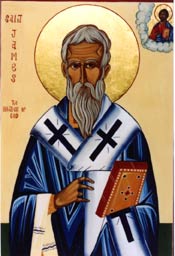
James of Jerusalem, Martyr -- Oct. 23


Briefly mentioned in New Testament passages, most notably 1Cor. 15:7 where Paul reports that he sees the risen Lord, James of Jerusalem is recognized as an early leader in the Church in Jerusalem. According to Galatians 2:9, Paul writes that James' mission is to the Jews.
...and when James and Cephas and John, who were acknowledged pillars, recognized the grace that had been given to me, they gave to Barnabas and me the right hand of fellowship, agreeing that we should go to the Gentiles and they to the circumcised...
James is recognized as the first bishop of Jerusalem, the "Bishop of bishops." In Festivals and Commemorations, Rev. Philip Pfatteicher writes,
Jewish Christianity exalted him above Peter and Paul since his ministry was in the principal city of the Holy Land. He remained the most respected and authoritative leader in Jerusalem for most of the Christian generation, no doubt because of his eyewitness testimony to the risen Jesus.
James is according to accounts put to death by temple authorities, just when remains the issue. Josephus says he was stoned to death in 62, but another source says that during Passover before the siege in 66, James claimed that Jesus was the Son of Man, and then that he was thrown from the temple, then stoned and beaten. Whenever it was, James' confession of Jesus as Messiah is the catalyst for his martyrdom.

Given recent discussions of Islamic martyrdom in media circles, martyrdom is generally seen as a negative reaction. Evidently one can take one's faith too far. Christian martyrs (remember martyr means "witness" or "one who gives testimony") are not active in seeking their own deaths let alone others. Christian martyrs proclaim Jesus as Lord and accept the consequences, even if others put them to death for their proclamation.

Does the Church now raise up people who would accept martyrdom? Perhaps the more important question to be raised first is, "Does the Church raise up people who may faithfully proclaim Jesus as Messiah in all things?" This proclamation is far from just talking Jesus, like the church group I saw this past weekend at a very popular state park. A short distance from the restrooms the group sat in a circle, and as my sons and I walked around waiting for my wife to finish in the restroom, the group broke into "Our God Is an Awesome God" and then into some warrior-type chant. "Give me a 'J.' Give me an 'E.'... What's that spell? JESUS! Who do you love? JESUS!...Who's coming back soon? JESUS!" Is that proclamation? More importantly is that proclamation worth dying for? Will it form a people to proclaim Jesus in such a way that others hate you for it?

Or is it safe proclamation? Set apart from the crowd, they circled up, sang their song, did their cheer, and felt good about what they said. Did it actively engage non-believers? Did they show the love that is to make us known to others? With martyrs, there is an active engagement of the political realm, with society (political not meaning just the civil authorities, but the life we live together in society). Most Christians I would say are formed now to be non-threatening to the political order. Christians are safe. If we appear to take the Gospe too seriously, we are labelled with terms like "radical" and "trouble maker."

James' engagement with the authorities of his time led to his death. The martyrs give us the example about how we proclaim the gospel extravagantly and without reserve. Let us give thanks for all who are formed in that way, and pray that we may be formed the same.

Peace.

Saturday, October 21, 2006

God as Capitalist...

There are just so many signs that God has a bad business plan. Every time he moves to affirm that "the last shall be first, and the first shall be last," he scares away potential investors, loses market share, and pushes the most ambitious persons out of the firm. Elton Mayo may have built a kinder, gentler school of labor utitlization around the touchy-feely type of human relations (use compliments instead of threats, treat your workers well and they'll work for you, and all that), but you can't put the last first and the first last. The last are last for a reason--they're too stupid, or not sufficiently ruthless, or carrying too much baggage from prior exploitation or victimization. And if you don't put the first on top you're violating the natural order, setting up perverse incentives, and the evolution of better ideas, more efficient sorts of activities, and the creation of wealth.
These are just a few of the bad business practices that God, through Jesus, implements in the Gospels. But this isn't the enture story. Consider the strategies that God and Jesus don't practice that are part and parcel of every capitalistic enterprise. God not only does things guaranteed to frustrate economic rationality, God passes up other things that constitute good stewardship of economic resources and the production of value.
Consider, for example, the whole question of incentives. Contemporary capitalism lives in a world in which political entities offer incentives--tax breaks, subsidies, regulatory exemptions--to attract capitalist investment in one community rather than another. Illinois competes with Kentucky, the United States with Germany, Haiti with Honduras--while some people call corporate incentives a form of legal bribery, they're an important part oof what every good capitalist consideres in making investment decisions.
But not God. Not only does God seem decidedly lukewarm toward some traditional form of incentives (burnt offerings and sacrifices, for example), God doesn't seem attuned to locating where maximal return could be obtained. With all due respect to God's location team, choosing a backwater like Galilee as the site fo the incarnation, seems remakably short-sghted: doubtless the Romans would have offered a much more attractive package of temple construction, tax subsidies, and legal privileges were divinity to come in the form of the emperor(for real, not just in pagan terms) or some other imperial notable. But Galilee? Bad transportation infrastructure, far from religious markets, distant from suppliers, and not likely to jump from an ethnic/niche markey within Judaism to a worldwide commodity.
Michael L. Budde
"God Is Not a Capitalist"

Thursday, October 19, 2006

St. Luke, Evangelist -- Oct. 18

Why am I a day behind? Doh!

St. Luke is the one credited for writing the third gospel and its companion the book of Acts. And while his (or her for that matter) identity is largely unkown, Luke's gospel contains some of the most beloved parables, and most-used liturgical songs. If one makes it a habit of praying the Daily Offices, these canticles are heard often. One of the central pieces of Vespers is the Magnificat, Mary's Song which she sings when she visits her cousin Elizabeth.
Luke 1:46-55(NRSV) My soul magnifies the Lord, and my spirit rejoices in God my Savior, for he has looked with favor on the lowliness of his servant. Surely, from now on all generations will call me blessed; for the Mighty One has done great things for me, and holy is his name. His mercy is for those who fear him from generation to generation. He has shown strength with his arm; he has scattered the proud in the thoughts of their hearts. He has brought down the powerful from their thrones, and lifted up the lowly; he has filled the hungry with good things, and sent the rich away empty. He has helped his servant Israel, in remembrance of his mercy, according to the promise he made to our ancestors, to Abraham and to his descendants forever.
Then there are the songs of Zechariah, and of Simeon. We receive the beginning of the Gloria from the song of the angels at Jesus' birth.

Much of Luke's emphasis is on the reversal of the world with the coming of God's Reign. The poor and outcast are exalted, the rich and powerful are cast down. Luke's beatitudes are much earthier than Matthew's. There Luke writes "Blessed are the poor, for yours is the kingdom of God. (6:20)"

And one of the most beloved resurrection stories of Jesus happens in Luke. On the road to Emmaus, the two disciples see Jesus revealed to them in the breaking of the bread. St. Luke portrays Jesus, and later the Church, as active in the world, forgiving sin, helping the poor and outcast, healing the sick and proclaiming liberty to the captive.

May we continue to be that kind of Church.

Peace.

Wednesday, October 18, 2006

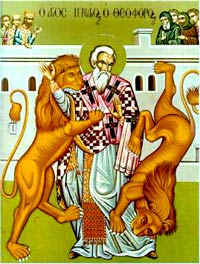
Ignatius of Antioch, Bishop and Martyr Oct. 17


Ok... so this should have been posted yesterday... technically.

From Ignatius' letters:
To the Trallians -- [Jesus Christ] is our Hope, and if we live in union with him, we shall gain eternal life. ...
Be deaf, then, of any talk that ignores Jesus Christ, of David's lineage, of Mary; who was really born, ate, and drank; was really persecuted under Pontius Pilate; was really crucified and died, in the sight of heaven and earth and the underworld. He was really raised from the dead, for his Father raised him, just as his Father will raise us, who believe on him, thought Christ Jesus apart from whom we have no genuine life.

To the Romans -- Just pray that I have the strength of soul and body so that I may not only talk [about martyrdom], but really want it. It is not that I merely want to be called a Christian, but actually to be one. Yes, if I prove to be one, then I can have the name. ... Our God Jesus Christ, indeed has revealed himself more clearly by returning to the Father. The greatness of Christianity lies in its being hated by the world, not in its being convincing to it. ...
Let me be fodder for wild beasts-- that is, how I can get to God. I am God's wheat and I am being ground by the teeth of wild beasts to make a pure loaf for Christ. ...
All the way from Syria to Rome, I am fighting with wild beasts, by land and sea, night and day, chained as I am to ten leopards (I mean to a detachment of soldiers), who only get worse the better you treat them. But by their injustices I am becoming a better disciple, "though not for that reason am I acquitted."...
May nothing seen or unseen begrudge me making my way to Jesus Christ. Come fire, cross, battling with wild beasts, wrenching of bones, mangling of limbs, crushing of my whole body, cruel tortures of the devil--only let me get to Jesus Christ! Not the wide bounds of earth nor the kingdoms of this world will avail me anything. "I would rather die" and get to Jesus Christ, than reign over the ends of the earth. That is whom I am looking for--the One who died for us. That is whom I want--the One who rose for us.
Peace.

Thursday, October 12, 2006

Is God Green?

Thanks to Nathan Mattox at Leaves from the Notebook of a Tamed Optimist, I caught the Moyers on America being shown on PBS last night. If you have not seen it, you can watch it here. Moyers highlighted the new direction of a growing number of evangelicals, as they find the necessity of environmental stewardship, deeply rooted in the Scriptures. At the end of the program, Moyers noted that even Pat Robertson is being convicted of the reality of global warming.

Moyers focused on a Vineyard church in the Northwest, and a group of Christians here in West Virginia, Christians for the Mountains, who are battling the horror of mountaintop removal. I was impressed with the actions of Christians there, not only in speaking out against the injustice perpetuated on the people of West Virginia, but also their actions in the works of mercy. Christians are carting potable water to people whose well water has been polluted by the toxic slurry and sludge that comes from processing coal.

I think one of the reasons that environmental stewardship is gaining momentum in evangelical circles is that the view is supported not only through the creation accounts and passages like Genesis 2:15, where humans are to care for creation, but also because environmental stewardship is seen more and more through Christological terms, that our salvation through Christ should have something to do with the creation around us.

The theologian protrayed as defending the conservative political stance, E. Calvin Beisner, was difficult to listen to. He claimed that pollution is part of the natural world, and so we should minimize it to the extent that we are able without interfering in the "forcible rule" that God granted human beings when we were given dominion over every living creature and told to subdue the earth (Gen. 1). It doesn't matter, he claims, if he ends up being wrong (which of course, he doesn't think he is), since his eternal salvation is secured. Maybe... but he will be judged for what he has taught, and according to James, teachers will be judged more harshly than the rest.

Let us pray for God's creation and our care exercised over it.

Peace.

Monday, October 09, 2006

Re-reading Resident Aliens

There is a community group that has gathered this past summer to read writers connected with The Ekklesia Project. We read D. Brent Laytham's book God Is Not... and now tonight we begin Stanley Hauerwas' and Wil Wilimon's Resident Aliens. This book is probably one of the most formative books I read in seminary (and in a pastoral care class! can you believe it??!?!). I am probably reading it for my fourth time now.

Just reading through the first chapter today, and I couldn't help but share a few quotes from the pages.

Tertullian was right--Christians are not naturally born in places like Greenville or anywhere else. Christians are intentionally made by an adventuresome church, which has again learned to ask the right questions to which Christ alone supplies the answers. (p. 19)

In Jesus we meet not a presentation of basic ideas about God, world, and humanity, but an invitation to join up, to become part of a movement, a people. By the very act of our modern theological attempts at translation, we have unconsciously distorted the gospel and transformed it into something it never claimed to be--ideas abstracted from Jesus, rather than Jesus with his people. (p. 21)

Right living is more the challenge than right thinking. The challenge is not the intellectual one but the political one--the creation of a new people who have aligned themselves with the seismic shift that has occured in the world since Christ. (p. 24)

The project, begun at the time of Constantine, to enable Christians to share power without being a problem for the powerful had reached its most impressive fruition. If Caesar can get Christians there to swallow the "Ultimate Solution," and Christians here to embrace the bomb, there is no limit to what we will not do for the modern world. Alas, in leaning over to speak to the modern world, we had fallen in. We had lost the theological resources to resist, lost the resources even to see that there was something worth missing. (p. 27)

That which makes the church "radical" and forever "new" is not that the church tends to lean toward the left on most social issues, but rather that the church knows Jesus whereas the world does not. (p. 28)

We cannot understand the world until we are transformed into persons who can use the language of faith to describe the world right. Everyone does not already konw what we mean when we speak of prayer. Everyone does not already believe that he or she is a sinner. We must be taught that we sin. That is, we must be transformed by a vision of a God who is righteous and just, who judges us on the basis of something more significant than merely what feels right for us. (p. 28)
Peace.

Thursday, October 05, 2006

Four Experiences of the Plurality of God...

In the most recent issue of Pro Ecclesia, a lecture from Oswald Bayer is re-printed, "The Plurality of the One God, and the Plurality of the Gods." In section four ("The Plurality of the One God"), Bayer writes,
If one is to appreciate the irreducibility of these distinctions (note: from preceding paragraphs--distinctions that remain in eternity, e.g. distinction between Creator and creatures, distinctions among the three persons of the Trinity and distinctions meant for the interim, e.g. law and gospel, the hidden and revealed God, faith and sight), one must take into the account the intersection of times in which we live. On the one hand, the Word of the Cross and the salvation it communicates to us in the present age is a guarantee of the future consummation of the world; on the other hand, we still experience the painful contradiction between the suffering and groaning of the creature of the old world and the promised creation in the new world. In accordance with this intersection of times, which is experienced as a rupture of times, we encounter God in four different ways. We encounter him in his wrath in that he convicts us of sin; we encounter him in another way in his forgiving love; we encounter him yet another way in his long-suffering, whereby he sustains the old world into its future through the institution of natural and political laws; and, above all, we encounter him in another way in his terrifying hiddenness, in which he works all in all --life and death--in a way that we cannot possibly unravel.
To be sure, in the interest of constructing an agreeable and integrated system, many a theologian has tried to construe God's wrath, long-suffering and, above all, his terrifying hiddenness as aspects of his love. To do so, however, is to succumb to impatience, indeed, to a kind of enthusiasm. From our perspective (i.e., for us as long as we are wayfarers), the unity of God qua love and, with it, the unity of time qua eternity (i.e., an eternity that would bring unity and healing to this rupture of times) are not matters of demonstration; were it otherwise, lamentations and supplication would be superfluous. The unity of God qua love can be perceived only in a doxological context; it is the ground and object of confessing faith--which speaks assertologically--and of the hope that this implies.
Bayer loses me in his last sentence, but the point of these paragraphs is that we should not rush to condense all four experiences into one, a forced and dissatisfying unity. In this intersection of times, the interim, we are forced to hold these things in tension and he urges us not to relax them.
As pastors, we are called to relax these tensions all the time. Is Aunt Mathilda going to hell? Why did this happen to me (or more precisely, why did God cause this to happen to me)? Why doesn't God tell me what I should do? We collapse the aspects of the tensions to make people feel comfortable. In this interim time, there will be great discomfort as the old is abraded by the new. The old adam dies after all, but it doesn't die easily. The old life dies kicking and screaming the whole way. We, who preach the gospel, in the midst of the struggle of death and new life, must not rush to release the tension. We must continue to point as Bayer noted at the opening of that first paragraph, the Word of the Cross. The Cross communicates a word of salvation to us. In this tension, here there is located a guarantee of what the world will become. We will die, but be raised. We will see, but now it is unclear. But we cling to the hope that God is at work healing and restoring creation, transforming our lives even in the midst of this rupture in time, and for that we praise God.

Peace.

Friday, September 29, 2006

The Church of Christ in every age...

The Church of Christ bears witness to the end of all things. It lives from the end, it thinks from the end, it acts from the end, it proclaims its message from the end. "Remember not the former things, nor consider the things of old. Behold, I am doing a new thing" (Isa. 43.18-19). The new is the real end of the old; Christ is the new. Christ is the end of the old. He is not a continuation of the old; he is not its aiming point, nor is he a consummation upon the line of the old; he is the end and therefore the new.
Within the old world the Church speaks of the new world. And because the Church is more certain of the new world than of anything else it recognizes the old world only in the light of the new. The old world cannot take pleasure in the Church because the Church speaks of its end as though it had already happened--as though the world had already been judged. The old world does not like being regarded as dead. The Church has never been surprised by this, nor is it surprised by the fact that again and again men come to it who think the thoughts of the old world--and who is there entirely free from them.
Dietrich Bonhoeffer
from the Introduction to Creation and Fall

Wednesday, September 27, 2006

Vincent de Paul -- friend of the poor

Today is Vincent de Paul's feast day. James Kiefer's Hagiography page has a wonderful explanation of his life. I was struck by the following.
In 1625 he established the Congregation of the Mission (now known as the Vincentians, or the Lazarists), a community of priests who undertook to renounce all ecclesiastical advancement and devote themselves to work in the small towns and villages of France. In an age not noted for "interdenominational courtesy," he instructed his missioners that Protestants were to be treated as brothers, with respect and love, without patronage or condescension or contentiousness. Wealthy men and women came to him, expressing a wish to amend their lives, and he organized them into a Confraternity of Charity, and set them to work caring for the poor and sick in hospitals and in home visits. In 1633 the Archbishop or Paris gave him the Priory of St Lazare as a headquarters. There he offered retreats six times a year for those who were preparing for the ministry. These lasted two weeks each, and each involved about eighty students. He then began to offer similar retreats for laypersons of all classes and widely varying backgrounds.
Perhaps he should be remembered as ecumenist as well?

Kiefer notes that his sermons drew penitents both rich and poor, who sought amendment of life. Such is the power of the Word spoken faithfully. If we exchange the gospel for something other than it, we preachers steal human beings of their dignity, leaving them instead to die in the rot of sin. The mistake, I think, is that we too often want people to live better lives. For better lives, all that is needed is maybe a different perpsective, or a little more effort, or just a warm feeling generated by some therapeutic message ("God's good life... NOW!" or whatever other dreck is being pushed).

Christ seeks to give us a new life -- see that... NEW. As Bonhoeffer said, "When Christ calls a man, he bids him come and die." A new life is the perogative of God. Only God can give that to us. And we are called to that new life, in the waters of baptism of course, but also in the daily dying and rising to sin. Christ calls us to repentance, and with repentance comes amendment of life. But why should we bother with that... when preachers give us the gruel, thin and tasteless, rather than the staff of life, the gospel. In the Gospel, Christ slays the sinful heart that the righteous heart might come forth, the heart upon which the Commandments are written.

As in every day and age, we need the Gospel preached that the Word of Life might awaken us. As Vincent awakened the penitents heart through the preaching of the Word, may we all be awakened.

Peace.

Tuesday, September 26, 2006

A Catholic... and a catholic understanding of how grace saves...

Over at Evangelical Catholicism, Michael posted a very nice piece "A Catholic Understanding of How Grace Saves." I commented that Lutherans have been there all along.

I think it is perhaps true however that we have lost the notion that there is need for perseverance. But we persevere in our faith as we engage in the practices of the Christian life.

Michael writes,
The Christian is not saved by faith alone (Jas 2:14-26), but by grace alone (Eph 2:8-9) through a faith that is not mere belief, but through a faith that is completed by obedience (Rom 1:5, 16:26) and love (Gal 5:6), that is, by keeping the commandments of the Lord (Jn 15:6-10; Gal 5:17-21) and working out salvation in acts of charity and goodwill (Mt 25:31-46; Phil 2:12-13). Indeed, faith is never without works.
I am reminded of Bonhoeffer who wrote, "To believe is to obey, and to obey is to believe."

Read his article. It is quite good.

Peace.

Saturday, September 23, 2006

Hermeneutics

Too many preachers continue to believe that something called "human nature" forms the hermeneutical bridge between the many generations seperating the biblical world and our own. But is it really true that no matter how distant we are from our ancestors, we all share in an ideal essence of humanity unconditioned by history or changing worldviews? Is that what really makes us brothers and sisters to David, Ruth, Peter, Paul, and the Corinthians? It should be that easy! We have enough difficulty recognizing the humanity of our contemporaries of other races, sexual orientations, and nationalities to warn us away from placing our confidence in a trans-generational bond of human nature.

The common denominator between Christians is not human nature but the church, which, as always, can be found gathered around lectern and pulpit, where it listens attentively for a word from the Lord, and scattered throughout the world, where it attempts to perform the word with integrity.
Richard Lischer, The End of Words: The Language of Reconciliation in a Culture of Violence

Friday, September 22, 2006

warfare in the office...


Ok... so I came across THESE while doing a completely different search on google, and I see that they were posted back in December of 2005, but I am disconcerted. Now there is a part of me that finds these amusing in an impish sort of way, but given the war-mania that exists, I cringe at the thought of waging war in the office... and after all, offices can be brutal war zones without these.

I wonder what this says about us as a people that our "toys" are modeled after weapons. Notice that the description on the website is "air darts" but they are really missiles. What we do is who we become. At its heart, that is the basis of the Christian life, a life full of habits and practices that school us in the virtues of primarily, faith, hope and charity. The modern world has eroded our sense of what is central to life with distractions like these darts that keep us from becoming the people God intends for us.

It's all fun and games until someone loses an eye virtue.

Peace.

Thursday, September 21, 2006

A proper media read of the Pope...

The column by Kathleen Parker that appeared in my paper today, "Translating the Pope" was really right on, even if Parker's beginning was really meant to provoke. I found that she was right on in her assessment. Once you get past the provoking, she gets reasonable. She writes:

The single line extracted from the pope's lecture to inflame the highly flammable is an excerpt from a 14th-century dialogue between the Byzantine emperor Manuel II Paleologus and ``an educated Persian'' about Christianity and Islam. Said the emperor:

``Show me just what Muhammad brought that was new, and there you will find things only evil and inhuman, such as his command to spread by the sword the faith he preached.''

This one-sentence quotation was part of a wide-ranging discussion about the intersection of faith and reason, as well as the contradictory nature of religion and violence. Pope Benedict's key point was that faith through violence is unreasonable and, therefore, incompatible with the nature of God.

``The decisive statement in this argument against violent conversion is this: not to act in accordance with reason is contrary to God's nature,'' he said.

Think fast: Who wants to spread faith with violence? Not missionary nuns in Somalia. Who wants to slit the throats of infidels? Not the Southern Baptist Convention.

Contrary to what fanatics have insisted, the pope was as critical of the West as of Islam, if not more so. While Islam suffers faith without reason, he said that Western culture suffers from reason without faith.

His point was that the two cultures cannot enter into a productive dialogue unless they both recognize that faith and reason are inextricably bound. Islam has to drop its sword and the West has to make room for the divine.

Pope Benedict's view is that by ignoring faith, the West -- but especially Europe -- is ill-equipped to engage a culture that is so firmly entrenched in faith.

``A reason which is deaf to the divine and which relegates religion into the realm of subcultures is incapable of entering into the dialogue of cultures,'' he said. Likewise, a faith-based culture that abhors reason cannot engage in civilized discourse or advance the goal of harmony.

In a nutshell, those are the central points of the pope's lecture. How interesting that the emperor and the Persian could debate these issues several centuries ago, but 21st-century man is driven mad by ideas that challenge him.


In the West, we have so blindly driven away faith from our life, that we are incomprehensible to those who make faith a matter of life and death. We may pay lip service to faith, but only as far as it is therapeutic and non-binding. While I whole-heartedly will condemn violence in the name of religion, what else is worth dying for? Those of us who follow Jesus should know the answer... absolutely nothing. Christianity is about bearing the cross and learning to die rightly.

The blind acceptance of reason's primacy over faith says something different. "Don't die! Be happy and contented with what you have and seek more." The Cross is foolishness to the wise, but to we who are perishing it is the wisdom of God.

Peace.

Wednesday, September 20, 2006

The Pope and Muslims...

Given the recent arguing over Pope Benedict's comments regarding religion and violence, Islam, and the place of reason within religions, I went to the Vatican library and read through the declaration from Vatican II, THE RELATION OF THE CHURCH TO NON-CHRISTIAN RELIGIONS (Nostra Aetate).

Regarding Muslims the declaration says:

3. The Church regards with esteem also the Moslems. They adore the one God, living and subsisting in Himself; merciful and all- powerful, the Creator of heaven and earth,(5) who has spoken to men; they take pains to submit wholeheartedly to even His inscrutable decrees, just as Abraham, with whom the faith of Islam takes pleasure in linking itself, submitted to God. Though they do not acknowledge Jesus as God, they revere Him as a prophet. They also honor Mary, His virgin Mother; at times they even call on her with devotion. In addition, they await the day of judgment when God will render their deserts to all those who have been raised up from the dead. Finally, they value the moral life and worship God especially through prayer, almsgiving and fasting.

Since in the course of centuries not a few quarrels and hostilities have arisen between Christians and Moslems, this sacred synod urges all to forget the past and to work sincerely for mutual understanding and to preserve as well as to promote together for the benefit of all mankind social justice and moral welfare, as well as peace and freedom.

Forgetting the past doesn't seem to be the best strategy, since even though I believe Benedict, his "forgetting" meant including remarks from a Byzantine who had some issues with Muslims.

Peace.


Tuesday, September 19, 2006

Sin boldly! -- in context...

I came across this quote that is often quoted out of context. Many people will be familiar with this quote of Luther's... or at least part of it. "Sin boldly!" And then people rationalize it to mean they can do whatever they want. But Luther writes this quote at the end of a letter to Phillip Melanchthon. Here is the last paragraph.
If you are a preacher of grace, then preach a true and not a fictitious grace; if grace is true, you must bear a true and not a fictitious sin. God does not save people who are only fictitious sinners. Be a sinner and sin boldly, but believe and rejoice in Christ even more boldly, for he is victorious over sin, death, and the world. As long as we are here [in this world] we have to sin. This life is not the dwelling place of righteousness, but, as Peter says, we look for new heavens and a new earth in which righteousness dwells. It is enough that by the riches of God’s glory we have come to know the Lamb that takes away the sin of the world. No sin will separate us from the Lamb, even though we commit fornication and murder a thousand times a day. Do you think that the purchase price that was paid for the redemption of our sins by so great a Lamb is too small? Pray boldly—you too are a mighty sinner.
Luther, M. 1999, c1963. Luther's works, vol. 48 : Letters I (J. J. Pelikan, H. C. Oswald & H. T. Lehmann, Ed.). Luther's Works. Vol. 48 (Vol. 48, Page 281-282). Fortress Press: Philadelphia
This text is not really about getting to do whatever we want to do... But it does I think speak to our knowledge of who we are. Don't think we have to be perfect for God to save us. God saves us true sinners. And we will continue in our sin because we are not yet fully and completely righteous. But read in the light of other writings of Luther, and especially in the light of Scripture, we do not just continue in our sin as if nothing has changed.

Christ lays our life bare. We die to the old rationalizations that we have built up around us. We know that we are sinners. We have fallen short of what God desires, but we should rejoice, because if we are "mighty sinners," then we are exactly the type of person that God is out to save... and transform. Do not fret if we continue to sin. Return to God and believe and rejoice in Christ even more.

Peace.

Tuesday, September 05, 2006

Book meme - Passed on from Catholic Anarchy

1. One book that changed your life: After Virtue by Alasdair MacIntyre

2. One book that you’ve read more than once: The Desire of the Nations by Oliver O’Donovan; The Lord of the Rings by Tolkien; Dune by Frank Herbert

3. One book you’d want on a desert island: Theology and Social Theory by John Milbank… I might actually be able to read it then, and in the same vein: Church Dogmatics by Karl Barth (can I have all the volumes?) or the Summa (all parts)… that way even if I don’t read them, I have ample paper for starting fires or the latrine…

4. One book that made you laugh: Hmmm… all that comes to mind is from 10th grade Cheaper By The Dozen… I know I have read books that made me laugh since then… really I know I have.

5. One book that made you cry: The Sparrow by Mary Doria Russell (absolutely awesome read… I cried when the main character actually verbalizes what happened to him).

6. One book that you wish had been written: The Handwriting Is On the Wall: Hearing God’s Voice Loud and Clear by???

7. One book that you wish had never been written: Most of the Star Trek: TNG novels… they just aren’t that good most of them… I don’t see this topic really impinging on any issues of expression, just wasting time reading bad stories.

8. One book you’re currently reading: Eldest by Christopher Paolini, The End of Words by Richard Lischer, Chi Running by Danny Dreyer

9. One book you’ve been meaning to read: The Spirit of Early Christian Thought by Robert Louis Wilken, The Nature of Doctrine by George Lindbeck, Doxology by Geoffrey Wainwright

I am tagging my friend Travis at his blog Fidelity to post the next book meme.

Peace.

Thursday, December 29, 2005

Pope Benedict's Sermon on Christmas Eve

A friend sent the link to the text of Pope Benedict's Christmas Eve sermon (Thanks Matt!). I found this following excerpt wonderful. It is highly resonant with Luther's sermon on the Nativity.

Pope Benedict preached on Psalm 2 and the phrase, "The Lord said to me, you are my son, this day have I begotten you.":
But there is more: in Jesus Christ, the Son of God, God himself became man. To him the Father says: “You are my son.” God's everlasting “today” has come down into the fleeting today of the world and lifted our momentary today into God's eternal today. God is so great that he can become small. God is so powerful that he can make himself vulnerable and come to us as a defenceless child, so that we can love him. God is so good that he can give up his divine splendour and come down to a stable, so that we might find him, so that his goodness might touch us, give itself to us and continue to work through us. This is Christmas: “You are my son, this day I have begotten you.” God has become one of us, so that we can be with him and become like him. As a sign, he chose the Child lying in the manger: this is how God is. This is how we come to know him. And on every child shines something of the splendour of that “today,” of that closeness of God which we ought to love and to which we must yield it shines on every child, even on those still unborn.
(The full text may be found at http://www.theglobeandmail.com .)

Luther's sermon is not dealing with Psalm 2, but the Nativity, and the phrase from Benedict, " he can make himself vulnerable and come to us as a defenceless child, so that we can love him," is reminiscent where Luther says that God's majesty is not what we contemplate in the Nativity but his utter human vulnerability. In the Incarnation, the Son of God becomes pure gospel. "Trust him! Trust him!" Luther cries. It is no wonder that Christmas is many Christians' favorite festival. Here we have a picture of God who comes to us in complete defenselessness, utter dependence, and yet to save. That God thinks enough of us to come to us is awesome on its own, but that God trusts us to be dependent on human parents is itself perhaps even more incredible.

Wednesday, December 21, 2005

Luther on the Annunciation...

To this poor maiden marvelous things were announced: that she should be the mother of the All Highest, whose name should be the Son of God. He would be a King and of his Kingdom there would be no end. It took a mighty reach of faith to believe that this baby would play such a role. Well, Mary might have said, “Who am I, little worm, that I should bear a King?” She shut her eyes and trusted in God who could bring all things to pass, even though common sense were against it; and because she believed, God did to her as he said…. there are here three miracles: that God and man should be joined in this Child, that a mother should remain a virgin; that Mary should have such faith as to believe that this mystery would be accomplished in her. The last is not the least of the three. The Virgin birth is a mere trifle for God; that God should become man is a greater miracle; but most amazing of all is that this maiden should credit the announcement that she, rather than some other virgin had been chosen to be the mother of God… [1]


[1] Bainton, Roland H., ed., Martin Luther’s Christmas Book, Augsburg, Minneapolis, 1948, pp. 14-15

Tuesday, December 20, 2005

Hans Urs von Balthasar on the Incarnation

From the online archive of Hans Urs von Balthasar, an excerpt of a Christmas meditation on the Incarnation.

But who will step out along this road that leads from God's glory to the figure of the poor Child lying in the manger? Not the person who is taking a walk for his own pleasure. He will walk along other paths that are more likely to run in the opposite direction, paths that lead from the misery of his own existence toward some imaginary or dreamed-up attempt at a heaven, whether of a brief pleasure or of a long oblivion. The only one to journey from heaven, through the world, to the hell of the lost, is he who is aware, deep in his heart, of a mission to do so; such a one obeys a call that is stronger than his own comfort and his resistance. This is a call that has complete power and authority over my life; I submit to it because it comes from a higher plane than my entire existence. It is an appeal to my heart, demanding the investment of my total self; its hidden, magisterial radiance obliges me, willy-nilly, to submit. I may not know who it is that so takes me into his service. But one thing I do know: if l stay locked within myself, if I seek myself, I shall not find the peace that is promised to the man on whom God's favor rests. I must go. I must enter the service of the poor and imprisoned. I must lose my soul if I am to regain it, for so long as I hold onto it, I shall lose it. This implacable, silent word (which yet is so unmistakable) burns in my heart and will not leave me in peace.
For all of our talk about the spirit of Christmas, Balthasar truly reaches into it. Too often we are told that the spirit of Christmas is inside each of us. NOT SO! There is no peace inside us. We must go as the shepherds did to behold the peace that laid in swaddling cloths in a manger.

Saturday, December 17, 2005

St. Gregory Thaumaturgus' Sermon on the Annunciation

Again have we the glad tidings of joy, again the announcements of liberty, again the restoration, again the return, again the promise of gladness, again the release from slavery. An angel talks with the Virgin, in order that the serpent may no more have converse with the woman. In the sixth month, it is said, the angel Gabriel was sent from God to a virgin espoused to a man. Gabriel was sent to declare the world-wide salvation: Gabriel was sent to bear to Adam the signature of his restoration; Gabriel was sent to a virgin, in order to transform the dishonour of the female sex into honour; Gabriel was sent to prepare the worthy chamber for the pure spouse; Gabriel was sent to wed the creature with the Creator; Gabriel was sent to the animate palace of the King of the angels; Gabriel was sent to a virgin espoused to Joseph, but preserved for Jesus the Son of God. The incorporeal servant was sent to the virgin undefiled. One free from sin was sent to one that admitted no corruption. The light was sent that should announce the Sun of righteousness. The dawn was sent that should precede the light of the day. Gabriel was sent to proclaim Him who is in the bosom of the Father, and who yet was to be in the arms of the mother. Gabriel was sent to declare Him who is upon the throne, and yet also in the cavern. The subaltern was sent to utter aloud the mystery of the great King; the mystery, I mean, which is discerned by faith, and which cannot be searched out by officious curiosity; the mystery which is to be adored, not weighed; the mystery which is to be taken as a thing divine, and not measured. "In the sixth month Gabriel was sent to a virgin." What is meant by this sixth month? What? It is the sixth month from the time when Elisabeth received the glad tidings, from the time that she conceived John. And how is this made plain? The archangel himself gives us the interpretation, when he says to the virgin: "Behold, thy relation Elisabeth, she hath also conceived a son in her old age: and this is now the sixth month with her, who was called barren." In the sixth month--that is evidently, therefore, the sixth month of the conception of John. For it was meet that the subaltern should go before; it was meet thai: the attendant should precede; it was meet that the herald of the Lord's coming should prepare the way for Him. In the sixth month the angel Gabriel was sent to a virgin espoused to a man; espoused, not united; espoused, yet kept intact. And for what purpose was she espoused? In order that the spoiler might not learn the mystery prematurely. For that the King was to come by a virgin, was a fact known to the wicked one. For he too heard these words of Isaiah: 4, Behold, a virgin shall conceive, and bear a son."And on every occasion, consequently, he kept watch upon the virgin's words, in order that, whenever this mystery should be fulfilled, he might prepare her dishonour. Wherefore the Lord came by an I espoused virgin, in order to elude the notice of the wicked one; for one who was espoused was pledged in fine to be her husband's. "In the sixth month the angel Gabriel was sent to a virgin espoused to a man whose name was Joseph." Hear what the prophet says about this man and the virgin: "This book that is sealed shall be delivered to a man that is learned." What is meant by this sealed book, but just the virgin undefiled? From whom is this to be given? From the priests evidently. And to whom? To the artisan Joseph. As, then, the priests espoused Mary to Joseph as to a prudent husband, and committed her to his care in expectation of the time of marriage, and as it behoved him then on obtaining her to keep the virgin untouched, this was announced by the prophet long before, when he said: "This book that is sealed shall be delivered to a man that is learned." And that man will say, I cannot read it. But why canst thou not read it, O Joseph? I cannot read it, he says, because the book is sealed. For whom, then, is it preserved? It is preserved as a place of sojourn for the Maker of the universe. But let us return to our immediate subject. In the sixth month Gabriel was sent to a virgin -- he who received, indeed, such injunctions as these: "Come hither now, archangel, and become the minister of a dread mystery which has been kept hid, and be thou the agent in the miracle. I am moved by my compassions to descend to earth in order to recover the lost Adam. Sin hath made him decay who was made in my image, and hath corrupted the work of my hands, and hath obscured the beauty which I formed. The wolf devours my nursling, the home of paradise is desolate, the tree of life is guarded by the flaming sword, the location of enjoyments is closed. My pity is evoked for the object of this enmity, and I desire to seize the enemy. Yet I wish to keep this mystery, which I confide to thee alone, still hid from all the powers of heaven. Go thou, therefore, to the Virgin Mary. Pass thou on to that animate city whereof the prophet spake in these words: 'Glorious things were spoken of thee, O city of God.' Proceed, then, to my rational paradise; proceed to the gate of the east; proceed to the place of sojourn that is worthy of my word; proceed to that second heaven on earth; proceed to the light cloud, and announce to it the shower of my coming; proceed to the sanctuary prepared for me; proceed to the hall of the incarnation; proceed to the pure chamber of my generation after the flesh. Speak in the ears of my rational ark, so as to prepare for me the accesses of hearing. But neither disturb nor vex the soul of the virgin.

Manifest thyself in a manner befitting that sanctuary, and hail her first with the voice of gladness. And address Mary with the saturation, 'Hail, thou that art highly favoured,' that I may show compassion for Eve in her depravation."

The archangel heard these things, and considered them within himself, as was reason able, and said: "Strange is this matter; passing comprehension is this thing that is spoken. He who is the object of dread to the cherubim, He who cannot be looked upon by the seraphim, He who is incomprehensible to all the heavenly powers, does He give the assurance of His connection with a maiden? does He announce His own personal coming? yea more, does He hold out an access by hearing? and is He who condemned Eve, urgent to put such honour upon her daughter? For He says: 'So as to prepare for me the accesses of hearing.' But can the womb contain Him who cannot be contained in space? Truly this is a dread mystery." While the angel is indulging such reflections, the Lord says to Him: "Why art thou troubled and perplexed, O Gabriel? Hast thou not already been sent by me to Zacharias the priest? Hast thou not conveyed to him the glad tidings of the nativity of John? Didst thou not inflict upon the incredulous priest the penalty of speechlessness? Didst thou not punish the aged man with dumbness? Didst thou not make thy declaration, and I confirmed it? And has not the actual fact followed upon thy announcement of good? Did not the barren woman conceive? Did not the womb obey the word? Did not the malady of sterility depart? Did not the inert disposition of nature take to flight? Is not she now one that shows fruitfulness, who before was never pregnant? Can anything be impossible with me, the Creator of all? Wherefore, then, art thou tossed with doubt?" What is the angel's answer to this? "O Lord," he says, "to remedy the defects of nature, to do away with the blast of evils, to recall the dead members to the power of life, to enjoin on nature the potency of generation, to remove barrenness in the case of members that have passed the common limit, to change the old and withered stalk into the appearance of verdant vigour, to set forth the fruitless soil suddenly as the producer of sheaves of corn,--to do all this is a work which, as it is ever the case, demands Thy power. And Sarah is a witness thereto, and along with her also Rebecca, and again Anna, who all, though bound by the dread ill of barrenness, were afterwards gifted by Thee with deliverance from that malady. But that a virgin should bring forth, without knowledge of a man, is something that goes beyond all the laws of nature; and dost Thou yet announce Thy coming to the maiden? The bounds of heaven and earth do not contain Thee, and how shall the womb of a virgin contain Thee?" And the Lord says: "How did the tent of Abraham contain me?" And the angel says: "As there were there the deeps of hospitality, O Lord, Thou didst show Thyself there to Abraham at the door of the tent, and didst pass quickly by it, as He who filleth all things. But how can Mary sustain the fire of the divinity? Thy throne blazes with the illumination of its splendour, and can the virgin receive Thee without being consumed?" Then the Lord says: "Yea surely, if the fire in the wilderness injured the bush, my coming will indeed also injure Mary; but if that fire which served as the adumbration of the advent of the fire of divinity from heaven fertilized the bush, and did not burn it, what wilt thou say of the Truth that descends not in a flame of fire, but in the form of rain?" Thereupon the angel set himself to carry out the commission given him, and repaired to the Virgin, and addressed her with a loud voice, saying: "Hail, thou that are highly favoured! the Lord is with thee. No longer shalt the devil be against thee; for where of old that adversary inflicted the wound, there now first of all does the Physician apply the salve of deliverance. Where death came forth, there has life now prepared its entrance. By a woman came the flood of our ills, and by a woman also our blessings have their spring. Hail, thou that are highly favoured! Be not thou ashamed, as if thou wert the cause of our condemnation. For thou art made the mother of Him who is at once Judge and Redeemer. Hail, thou stainless mother of the Bridegroom of a world bereft! Hail, thou that hast sunk in thy womb the death (that came) of the mother (Eve)! Hail, thou animate temple of temple of God! Hail, thou equal home of heaven and earth alike! Hail, thou amplest receptacle of the illimitable nature!" But as these things are so, through her has come for the sick the Physician; for them that sit in darkness, the Sun of righteousness; for all that are tossed and tempest-beaten, the Anchor and the Port undisturbed by storm. For the servants in irreconcilable enmity has been born the Lord; and One has sojourned with us to be the bond of peace and the Redeemer of those led captive, and to be the peace for those involved in hostility. For He is our peace; and of that peace may it be granted that all we may receive the enjoyment, by the grace and kindness of our Lord Jesus Christ; to whom be the glory, honour, and power, now and ever, and unto all the ages of the ages. Amen.

Found at http://www.newadvent.org/fathers/0609.htm

Tuesday, September 06, 2005

Interview with John Milbank

There is a fascinating interview with John Milbank over at The Other Journal. I am sure it will take a while before I digest and understand all that Milbank says here in his discussion of capitalism. But it is a very interesting read nonetheless. I am sure that I will have something to say about the interview at some point later on.

Grace and Peace,
Brian

Saturday, September 03, 2005

Response to Katrina and sin...

It can be escaped. As much as I try, I must wrestle with the hurricane and its dreadful aftermath. Internet news reports, television specials, newspaper accounts... all point to one huge fact. We are a sinful world. I don't mean this statement in the way some have meant it. New Orleans was not hit with a hurricane because it was more sinful than the rest of us. Katrina was not divine retribution. No.

What is apparent though is that we are sinful. No matter how we look at it, we are broken people who are curved in on ourselves, whether we are in the middle of the hurricane aftermath or not. In places that should have been sanctuaries, women were raped, and people killed. When the storm was coming, and people were evacuating, there were stories of people in SUV's leaving, but not taking others with them.

In the gospel lesson tomorrow, we hear the reading open with, "If another member of the Church sins against you..." So often we approach this part of Jesus' Church Sermon (Matt. 18) as a lesson on how to avoid conflict and be a healthy congregation by confronting those who sin against us. But WHAT IF, we approach this lesson from the other perspective... mainly that WE are the ones who are sinning against another brother or sister. Would we be ready to hear the accusations of another against us? Can we truly live in the Spirit and be open to our brother's or sister's solo approach? Will we be able to hear the cries of the Gulf Coast residents who cry out, "Where is our help? Why haven't you done anything?"

In this congregation, we have been studying the Large Catechism. Last Tuesday, we came across the fifth commandment, "You shall not kill." In his explanation, Luther radicalizes this commandment, so that none of us can say, "Ah! Kept that one!" Luther writes,
This, then is the brief summary of this commandment (to impress it most clearly upon the common people what this commandment means by “not killing”). First, we should not harm anyone, either by hand or deed. Next, we should not use our tongue to advocate or advise harming anyone. Furthermore, we should neither use nor sanction any means or methods whereby anyone may be mistreated. Finally, our heart should harbor no hostility or malice against anyone in a spirit of anger and hatred. Thus you should be blameless in body and soul toward all people, but especially toward anyone who wishes or does you evil. For to do evil to someone who desires good for you and does you good is not human but devilish.
In the second place, this commandment is violated not only when we do evil, but also when we have the opportunity to do good to our neighbors and to prevent, protect, and save them from suffering bodily harm or injury, but fail to do so. If you send a naked person away when you could clothe him, you have let him freeze to death. If you see anyone who is suffering from hunger and do not feed her, you have let her starve. Likewise, if you see anyone who is condemned to death or in similar peril and do not save him although you have means and ways to do so, you have killed him. It will be of no help for you to use the excuse that you did not assist their deaths by word or deed, for you have withheld your love from them and robbed them of the kindness by means of which their lives might have been saved.
You have withheld your love from them and robbed them of the kindness by means of which their lives might have been saved.

Is there anything more damning to us? As we respond, we are to respond in a way that would bring about the wholeness that God intends.

May we give till it hurts. Pray unceasingly. Bear the cross that we might truly live.

Grace and Peace,
Brian

Wednesday, August 31, 2005

Vocation and Faith

I once read an old ditty that went something like,

The businessman went to church,
He never missed a Sunday.
The businessman went to Hell,
For what he did on Monday.

How often is there a disconnect between our faith and our job? I would normally have pointed to the Enlightenment that produced the privatization of our faith, removing it from the public sphere, at least explicitly. However, I came across a section of Luther’s sermons on John (Luther’s Works, vol 24, ed. Pelikan, Oswald, Lehmann, Concordia Publishing), that speaks to issues of vocation and being a Christian that would seem to imply that there might have been something similar going on back then. I think Luther’s sermon can say something to us today.

In his sermon on John 15:5, Luther roots his discussion of whether or not one’s vocation is pleasing to the Lord in a discussion of baptism. He writes:

Therefore he who wants to be helped out of such doubt should be intent solely on coming out of himself and all his works into Christ and on learning to know how we come to grace through Him, are pleasing to God, and thus through faith are grafted into Him as branches. Then he can say: “I know, praise God, that unfortunately I am a poor and unworthy man and have deserved nothing but hell and wrath before God; but I also know that God is gracious to me for the sake of Christ the Lord, who suffered and died for my sin. And since I am in Christ and am cleansed by Him, God takes pleasure in my life and works, which proceed from such faith, and regards them as good fruit.”

Thus I can speak differently about my vocation and my activities from the way a heathen, a Turk, or an unbelieving saint can speak; for I am not only a prince or the head of a household, a man or a woman, who administers an office or vocation as the others also do; but I am also baptized and washed with the blood of Christ. This has nothing to do with my station or calling in life. For Baptism does not make me a prince, a subject, a husband, or anyone else; but it does make me a Christian. Furthermore, I also have the Word, which tells me that Christ died and rose again for me. This same Word makes no one a priest, a monk, a master, a servant, etc.; but it does create a heart that receives God’s grace and is cleansed by faith. This is what it means to be and remain in Christ. Then they may preach to me what they please; I adhere to the fact that I am baptized, not to my life and my vocation but to the Man called Jesus Christ.

Our sense of worth is not derived from our vocation, notice. Rather it comes out of being baptized. This baptism brings us into a particular way of life. At the end of the quote, Luther says, “I adhere to the fact that I am baptized, not to my life and my vocation but to the Man called Jesus Christ.” Baptism is the chief vocational foundation, because it unites us with Jesus Christ. We must not think that every vocation then is equal, or perhaps more precisely, not every way we can earn money to sustain ourselves can properly be called a vocation.

By rooting our primary allegiance to Jesus, there must then be certain jobs that are out. There are some ways of earning income that are impossible to remain faithful while doing. Our baptismal life is a free pass for us to do what we please. And just because we might be in a proper vocation does not mean that we cannot fall into sin carrying out our duties.

However, when we are faithful in carrying out whatever duties we have, then we may know that we please God. When we carry out fair buying and selling practices as a merchant, God is pleased. The temptations to cheat, steal and gouge competitors and customers is great. Formation in the faith is necessary so that one learns to trust God in all things, including one’s vocation.

Because our identities are rooted in our baptism, as folks who are united with Christ, our vocations then become good works that flow out of our identity as Christians. Because we approach our vocations as faithful children of God, we are sanctified. Wherever we occupy ourselves with the Word, and practice discipleship, God sanctifies us. Our very vocations become arenas for the formation of a Christian holy people, become the testing ground where our faith is exercised and Christian virtue is practiced. In that way then, our vocations become treasures for us in heaven, as Luther writes again,

Wherever there is such faith and assurance of grace in Christ, you can also confidently conclude with regard to your vocation and works that these are pleasing to God and are good and true Christian fruits. Furthermore,such temporal and physical works as governing a land and people, managing a house, rearing and teaching children, serving, toiling, etc., also develop into fruit that endures unto life everlasting.. Thus the holy patriarch Abraham and our holy ancestress Sarah will be commended and praised on Judgment Day for their marital life. Although the married estate will come to an end and will be no more, as will all the life and activity of this world, yet this holy Sarah and others with her, will receive their little crowns because they were pious spouses and mothers, not by reason of their works per se -- for these had to cease -- but because they did these works in faith. In like manner, the works of all Christians are performed to God’s everlasting pleasure; they will not be despised, as will those of non-Christians, but will have their eternal reward also in yonder life, because they are works done in Christ and grow from the Vine.
Our vocations are places where we live out our faith, and by them we are sanctified, becoming more and more like Christ. God is always pleased to see these fruits of faithful labor. Living out our faith is not always easy, in fact it requires death, death to the old ways. In our new life however, we are transformed into the image of Christ.

Grace and Peace,
Brian


Friday, August 26, 2005

A New Screwtape Letter?

In his column published today in the Pittsburgh Post-Gazette, Tony Norman brings to light correspondence between Pat Robertson and Lord Stinkblossom.

Norman raises the issues that are all too apparent. If only Norman would have remembered that to break Commandment 2-10 was to transgress the very first one as well. Nothing like a double dip!

Robertson's call to assasinate (and let's be honest... that was Robertson's intent) is a vicious hypocrisy and a terrible obstacle to the Gospel. When Christians call for the murder of anyone, it is a terrible witness to the good news of God in Christ Jesus.

Some may state that a pre-emptive assasination would be allowed if it saved life in the long run. If that is true, only a genuine authority of the state should call for it. Rather than call for a murder, why doesn't he marshall the forces that he does have at hand. Why doesn't Robertson call for his Christian Coalition to pray for Chavez? Why doesn't he call for some bold missionaries to enter Venezuela and preach the gospel?

Well, maybe that's not the best solution... after this outburst, I am almost convinced that Robertson couldn't identify the Gospel if it saved his soul.

Grace & Peace,

Brian

Wednesday, August 24, 2005

Brother Roger's Funeral

The following piece was in the NY Times...

For those who do not know, Brother Roger was the head of a distinctive monastic community in France, known as Taize. Taize is an ecumenical community made up of Lutheran, Roman Catholic and Reformed members. The community is probably best known for its style of worship which involves the many-fold repetition of short musical pieces that are most commonly verses of Scripture. The community gathers a wide variety of people from all over the world.

As the article states, Brother Roger was murdered in the middle of an evening worship service.

We continue to pray: Eternal rest, grant him, O Lord, and let light perpetual shine upon him.

Grace and Peace,
Brian
------------------------------------------------------------------------------------------
August 24, 2005

At His Funeral, Brother Roger Has an Ecumenical Dream Fulfilled

TAIZÉ, France, Aug. 23 - Brother Roger Schutz pursued many ecumenical dreams in his long life, but in death one of them came true: At a Eucharistic service celebrated Tuesday by a Roman Catholic cardinal for Brother Roger, a Swiss Protestant, communion wafers were given to the faithful indiscriminately, regardless of denomination.

Cardinal Walter Kasper, the president of the Vatican's council for the unity of Christians, who celebrated the Mass, said in a homily, "Yes, the springtime of ecumenism has flowered on the hill of Taizé." Beyond religious divisions, Brother Roger also abhorred the division between rich and poor. "Every form of injustice or neglect made him very sad," Cardinal Kasper said.

Brother Roger's community and friends, including President Horst Köhler of Germany and the retired archbishop of Paris, Jean-Marie Lustiger, attended the liturgy in the vast wooden monastery church at Taizé, while thousands more followed it on a huge screen in fields outside the church.

Brother Roger was 90 when he was stabbed to death by a Romanian woman, Luminita Solcan, 36, during an evening service in the church one week ago. His successor, the Rev. Alois Leser, a Roman Catholic priest from Germany, prayed for forgiveness: "With Christ on the cross we say to you, Father, forgive her, she does not know what she did."

The gathering here in the hills of eastern France under leaden, showery skies reflected the spirit, and also the popularity, of Brother Roger, the son of a Swiss Calvinist pastor, who first gathered followers here in 1940. The monastic community here encompasses about 90 members from 20 or so countries and virtually every Christian denomination. Four Roman Catholic priests from among the members celebrated the funeral Mass with Cardinal Kasper.

Brother Roger's simple wooden coffin, a wooden icon lying upon it, was carried into the church by brothers. It was followed by a group of Romanian children who had been visiting the community when Brother Roger was killed.

Brother Roger founded Taizé as a monastic order only a 10-minute drive from Cluny, the site of Europe's largest and best-known monastic abbey before its destruction during the French Revolution. In the 1970's, Taizé developed into a pilgrimage site where people from different countries and faiths gathered annually at Easter. Many returned, in sadness, on Tuesday. Holding candles, they followed his coffin in procession to the Taizé cemetery.

Petra Simmert, a schoolteacher from southern Germany, came with her husband and two children. She is Protestant, he Catholic; one child is Catholic, the other Protestant. "We're an ecumenical family," she said, with a laugh. Watching the funeral of Pope John Paul II on television, they saw Cardinal Joseph Ratzinger, now Pope Benedict XVI, give communion to Brother Roger, even though he was not Catholic. "That struck us," she said.