
For some reason, I found this funny... especially as a pastor.
Peace.
The risen Christ is no resuscitated corpse. His new body has properties that enable it at will, to appear and disappear within present history. Nor will the redeemed universe be a mere repetition of its present state. This current universe is a creation endowed with just those physical properties that have enabled it to 'make itself' in the course of its evolving history. A world of this kind, by its necessary nature, must be a world of transience in which death is the cost of new life. In theological terms, this world is a creation that is sustained by its Creator, and which has been endowed with a divinely purposed fruitfulness, but which is also allowed to be at some distance from the veiled presence of the One who holds it in being and interacts in hidden ways with its history. Its unfolding process develops within the 'space' that God has given it, within which it is allowed to be itself. This is a theme that has been developed by particularly by Jürgen Moltmann. He draws on the kabbalistic notion of zimzum, the divine making way for the existence of created reality. One may sum up this insight by saying that this creation is the result of a kenotic act by the Creator, who has made way for the existence of the created other. The physical fabric of such a universe must take a particular form, but there is no reason to suppose that the Creator cannot bring into being a new creation of different character when it is appropriate to the divine purpose to do so.
The world to come will indeed have a different character. Just as Jesus was exalted to the right hand of the Father after his resurrection, so the world to come will be integrated in a new and intimate way with the divine life. I do not accept panentheism (the idea that the creation is in God though God exceeds creation) as a theological reality for the present world, but I do believe in it as the form of eschatological destiny for the world to come. As Paul wrote to the Corinthians, God will then be 'all in all' (I Corinthians 15:28). The Eastern Orthodox speak of eschatological fulfillment as being the attainment of theosis, not meaning by that that creatures will become gods but that they will share fully in the divine life and energies. This world is one that contains the focussed and covenanted occasions of divine presence that we call sacraments. The new creation will be wholly sacramental, suffused with with the presence of the life of God. In his great vision of the End, the seer of Patmos saw the holy city as one in which there was no longer a cultic temple 'for its temple is the Lord God the Almighty and the Lamb' (Revelation 21:22). God's presence, veiled from us today, will be open and manifest in the world to come. Moltmann has his own way of expressing this hope, in terms of the descent of the divine Shekinah.
 John 1:35-42
On his hagiography page, James Kiefer notes that the bishopric of
But what are we sent to do? Proclaim the good news, right… but does that mean accosting folks on the street in guerilla-style evangelism asking if they have accepted Jesus Christ as their Lord and Savior? I don’t think so. Being sent touches upon our notion of vocation, what we are called to do. The very jobs that allow us to earn our daily bread should not be disconnected from our sense of our identity as Christians. If those occupations are, then we are in trouble. Whether we work in the world as a busboy or a high-tech CEO, or we stay at home as a parent, our vocations better reflect the discipleship we claim.
So some applications:
Busboys, cooks, and other restaurant workers: You are sent into a ministry of hospitality. You are means to people’s daily bread. When your customers (for those who are Christian) pray, “Give us this day our daily bread” they have just prayed for you, as you have become part of what God uses to provide for people’s daily needs.
Nurses, doctors and other healthcare professionals: You are sent into a ministry of healing. You are signposts to the wholeness that God promises in the Kingdom. You stand against the forces of darkness and brokenness as bodies rebel against themselves. You participate in the healing miracles of Jesus.
All of us bear the title, apostle, on our brow as we have been baptized and marked with the cross of Christ forever. We remember apostles to remember that all of us are sent into the world. At the end of each Communion liturgy, we sing:
Thank the Lord and sing his praise; tell ev'ryone what he has done.
Let all who seek the Lord rejoice and proudly bear his name.
He recalls his promises and leads his people forth in joy
with shouts of thanksgiving. Alleluia. Alleluia.
We are sent to proclaim what God has done, in all that we do. We remember those who have showed us how.
Because Jesus lives, rules and will judge as the particular person he is, the outcome of history will be different than could otherwise have expected—also with respect to its having any outcome at all. We must ask, in all deliberate naivete. How different? What does the gospel promise?
The whole of Christian theology can be understood as the attempt to answer this question. A systematic theology's proposal will therefore not emerge only in a final section thematically devoted to it. This work's offering became explicit within the first few chapters: the gospel's promises inclusion in the triune community by virtue of union with Christ and just so in a perfected human community.
That is, the gospel promises what this work has described in various connections and called deification, following the example of the fathers. So Basil the Great: the final result of the Spirit's work in us is "endless joy in the presence of God, becoming like God, and... becoming God." We should note the dialectics of Basil's vision: we will simultaneously be with God and so other than he, like God in sanctity and righteousness, and personally identified with God. Or let us again quote Martin Luther, to dispel any suspicion that interpretation of salvation as deification may be an Eastern peculiarity: "Our shame is great, that we were the devil's children. But the honor is much greater, that we are children of God. For what greater fame and pride could we have... than to be called the children of the Highest and to have all he is, and has?"


... we need to be forming people now to be the type who can proclaim the gospel, who know that Christianity is not just a religion that binds us to some hierarchical structure, but a way of life that binds us to the God of the universe. We rely on reason only after having had the gospel revealed to us, not secretly as much of reason is revealed to the specialists who can afford the education, but openly and publicly from the pulpit, the altar and the font.The public nature of our liturgy is such that the good news of God in Christ Jesus is proclaimed to all. Our hymns, liturgies, sermons, and sacraments are all about informing and forming people to be the Church, the holy people of God. There are times we rightly place our confidence in biblical scholars, those who are educated specifically for the ministry of interpreting the texts of the bible. But we should not forget that our liturgy forms us all to interpret the message of Scripture.
God's Word forever shall abide,Perhaps it was just the moment. After all, A Mighty Fortress should stir the heart of any Christian, but on Reformation Sunday, Lutherans cannot help but feel some affinity towards this hymn which sets the core of the Christian faith to hymnody. The other possibility working on me there however, could have been that I read the article in the November 2006 issue of Wired, "The Church of the Non-Believers. (read the whole article)"
No thanks to foes who fear it;
For God himself fights by our side
With weapons of the Spirit.
Were they to take our house,
Goods, honor, child or spouse,
Though life be wrenched away,
They cannot win the day.
The Kingdom's ours forever!
...the big war is not between evolution and creationism, but between naturalism and supernaturalism. ...the "sensible" religious people are really on the side of the fundamentalists, because they believe in supernaturalism. That puts me on the other side.The question is what is the position of reason? Does reason reign supreme? Wolf moves here to talk about Sam Harris, author of The End of Faith: Religion, Terror and the Future of Reason. Harris sees an apocalypse brought on by religious faith, which will destroy the world. Harris wants to elevate reason to be the object of religion. Harris says,
We would have realized the rational means to maximize human happiness. We may all agree that we want to have a Sabbath that we take really seriously - a lot more seriously that most religious people take it. But it would be a rational decision, and it would not be just because it's in the Bible. We would be able to invoke the power of poetry and ritual and silent contemplation and all the variables of happiness so that we could exploit them. Call it prayer, but we would have prayer without bullshit.Where to start at a comment like that? Frankly, if I am going to be converted to atheism, I don't really want religion in another guise. After all religion's root meaning is about being bound. William Cavanaugh, in "God is Not Religious", writes,
The word derives from the Latin religio, a minor term that did not originally mean what we take religion to mean today. Religio referred to a binding obligation (from re + ligare, to rebind); to say that something was "religio to me" meant that it represented a special obligation. (from God Is Not... ed. D. Brent Laytham)Show me how true happiness is not found in religion at all. Don't give me pseudo-religious babble about the power of poetry, ritual and contemplation, let alone the variables of happiness (what does that mean?). Don't borrow the language of the world's religions to elevate reason to the place of primacy in the world. Give me something new... or else, I will simply dismiss you as a derivative hack seeking to bind me to you.
Prophecy, I've come to realize, is a complex meme (note: meme is a theoretical invention of Dawkins, a cultural replicator that spreads like brain to brain, like a virus). When prophets provoke real trouble, bring confusion to society by sowing reverberant doubts, spark an active, opposing consensus everywhere - that is the sign they've hit a nerve. But what happens when they don't hit a nerve? There are plenty of would-be prophets in the world, vainly peddling their provocative claims. Most of them just end up lecturing to undergraduates, or leading little Christian sects, or getting into Wikipedia edit wars, or boring their friends. An unsuccesful prophet is not a martyr, but a sort of clown.So maybe now... there is no need for urgency. But maybe we need to be forming people now to be the type who can proclaim the gospel, who know that Christianity is not just a religion that binds us to some hierarchical structure, but a way of life that binds us to the God of the universe. We rely on reason only after having had the gospel revealed to us, not secretly as much of reason is revealed to the specialists who can afford the education, but openly and publicly from the pulpit, the altar and the font.
19. That person does not deserve to be called a theologian who looks upon the invisible things of God as though they were clearly perceptible in those things which have actually happened [Rom. 1.20]. **Lift high the cross.
20. He deserves to be called a theologian, however, who comprehends the visible and manifest things of God seen through suffering and the cross.
21. A theologian of glory calls evil good and good evil. A theologian of the cross calls the things what it actually is.
22. That wisdom which sees the invisible things of God in works as perceived by man is completely puffed up, blinded and hardened.
23. The law brings the wrath of God, kills, reviles, accuses, judges, and condemns everything that is not in Christ [Rom. 4.15].
24. Yet that wisdom is not of itself evil, nor is the law to be evaded; but without the theology of the cross man misuses the best in the worst manner.
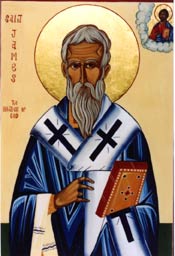
...and when James and Cephas and John, who were acknowledged pillars, recognized the grace that had been given to me, they gave to Barnabas and me the right hand of fellowship, agreeing that we should go to the Gentiles and they to the circumcised...James is recognized as the first bishop of Jerusalem, the "Bishop of bishops." In Festivals and Commemorations, Rev. Philip Pfatteicher writes,
Jewish Christianity exalted him above Peter and Paul since his ministry was in the principal city of the Holy Land. He remained the most respected and authoritative leader in Jerusalem for most of the Christian generation, no doubt because of his eyewitness testimony to the risen Jesus.James is according to accounts put to death by temple authorities, just when remains the issue. Josephus says he was stoned to death in 62, but another source says that during Passover before the siege in 66, James claimed that Jesus was the Son of Man, and then that he was thrown from the temple, then stoned and beaten. Whenever it was, James' confession of Jesus as Messiah is the catalyst for his martyrdom.
There are just so many signs that God has a bad business plan. Every time he moves to affirm that "the last shall be first, and the first shall be last," he scares away potential investors, loses market share, and pushes the most ambitious persons out of the firm. Elton Mayo may have built a kinder, gentler school of labor utitlization around the touchy-feely type of human relations (use compliments instead of threats, treat your workers well and they'll work for you, and all that), but you can't put the last first and the first last. The last are last for a reason--they're too stupid, or not sufficiently ruthless, or carrying too much baggage from prior exploitation or victimization. And if you don't put the first on top you're violating the natural order, setting up perverse incentives, and the evolution of better ideas, more efficient sorts of activities, and the creation of wealth.Michael L. Budde
These are just a few of the bad business practices that God, through Jesus, implements in the Gospels. But this isn't the enture story. Consider the strategies that God and Jesus don't practice that are part and parcel of every capitalistic enterprise. God not only does things guaranteed to frustrate economic rationality, God passes up other things that constitute good stewardship of economic resources and the production of value.
Consider, for example, the whole question of incentives. Contemporary capitalism lives in a world in which political entities offer incentives--tax breaks, subsidies, regulatory exemptions--to attract capitalist investment in one community rather than another. Illinois competes with Kentucky, the United States with Germany, Haiti with Honduras--while some people call corporate incentives a form of legal bribery, they're an important part oof what every good capitalist consideres in making investment decisions.
But not God. Not only does God seem decidedly lukewarm toward some traditional form of incentives (burnt offerings and sacrifices, for example), God doesn't seem attuned to locating where maximal return could be obtained. With all due respect to God's location team, choosing a backwater like Galilee as the site fo the incarnation, seems remakably short-sghted: doubtless the Romans would have offered a much more attractive package of temple construction, tax subsidies, and legal privileges were divinity to come in the form of the emperor(for real, not just in pagan terms) or some other imperial notable. But Galilee? Bad transportation infrastructure, far from religious markets, distant from suppliers, and not likely to jump from an ethnic/niche markey within Judaism to a worldwide commodity.
 Why am I a day behind? Doh!
Luke 1:46-55(NRSV) My soul magnifies the Lord, and my spirit rejoices in God my Savior, for he has looked with favor on the lowliness of his servant. Surely, from now on all generations will call me blessed; for the Mighty One has done great things for me, and holy is his name. His mercy is for those who fear him from generation to generation. He has shown strength with his arm; he has scattered the proud in the thoughts of their hearts. He has brought down the powerful from their thrones, and lifted up the lowly; he has filled the hungry with good things, and sent the rich away empty. He has helped his servant Israel, in remembrance of his mercy, according to the promise he made to our ancestors, to Abraham and to his descendants forever.Then there are the songs of Zechariah, and of Simeon. We receive the beginning of the Gloria from the song of the angels at Jesus' birth.
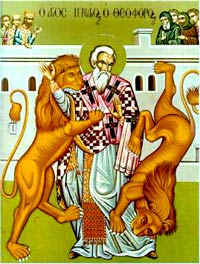
To the Trallians -- [Jesus Christ] is our Hope, and if we live in union with him, we shall gain eternal life. ...Peace.
Be deaf, then, of any talk that ignores Jesus Christ, of David's lineage, of Mary; who was really born, ate, and drank; was really persecuted under Pontius Pilate; was really crucified and died, in the sight of heaven and earth and the underworld. He was really raised from the dead, for his Father raised him, just as his Father will raise us, who believe on him, thought Christ Jesus apart from whom we have no genuine life.
To the Romans -- Just pray that I have the strength of soul and body so that I may not only talk [about martyrdom], but really want it. It is not that I merely want to be called a Christian, but actually to be one. Yes, if I prove to be one, then I can have the name. ... Our God Jesus Christ, indeed has revealed himself more clearly by returning to the Father. The greatness of Christianity lies in its being hated by the world, not in its being convincing to it. ...
Let me be fodder for wild beasts-- that is, how I can get to God. I am God's wheat and I am being ground by the teeth of wild beasts to make a pure loaf for Christ. ...
All the way from Syria to Rome, I am fighting with wild beasts, by land and sea, night and day, chained as I am to ten leopards (I mean to a detachment of soldiers), who only get worse the better you treat them. But by their injustices I am becoming a better disciple, "though not for that reason am I acquitted."...
May nothing seen or unseen begrudge me making my way to Jesus Christ. Come fire, cross, battling with wild beasts, wrenching of bones, mangling of limbs, crushing of my whole body, cruel tortures of the devil--only let me get to Jesus Christ! Not the wide bounds of earth nor the kingdoms of this world will avail me anything. "I would rather die" and get to Jesus Christ, than reign over the ends of the earth. That is whom I am looking for--the One who died for us. That is whom I want--the One who rose for us.
Peace.
Tertullian was right--Christians are not naturally born in places like Greenville or anywhere else. Christians are intentionally made by an adventuresome church, which has again learned to ask the right questions to which Christ alone supplies the answers. (p. 19)
In Jesus we meet not a presentation of basic ideas about God, world, and humanity, but an invitation to join up, to become part of a movement, a people. By the very act of our modern theological attempts at translation, we have unconsciously distorted the gospel and transformed it into something it never claimed to be--ideas abstracted from Jesus, rather than Jesus with his people. (p. 21)
Right living is more the challenge than right thinking. The challenge is not the intellectual one but the political one--the creation of a new people who have aligned themselves with the seismic shift that has occured in the world since Christ. (p. 24)
The project, begun at the time of Constantine, to enable Christians to share power without being a problem for the powerful had reached its most impressive fruition. If Caesar can get Christians there to swallow the "Ultimate Solution," and Christians here to embrace the bomb, there is no limit to what we will not do for the modern world. Alas, in leaning over to speak to the modern world, we had fallen in. We had lost the theological resources to resist, lost the resources even to see that there was something worth missing. (p. 27)
That which makes the church "radical" and forever "new" is not that the church tends to lean toward the left on most social issues, but rather that the church knows Jesus whereas the world does not. (p. 28)
We cannot understand the world until we are transformed into persons who can use the language of faith to describe the world right. Everyone does not already konw what we mean when we speak of prayer. Everyone does not already believe that he or she is a sinner. We must be taught that we sin. That is, we must be transformed by a vision of a God who is righteous and just, who judges us on the basis of something more significant than merely what feels right for us. (p. 28)
If one is to appreciate the irreducibility of these distinctions (note: from preceding paragraphs--distinctions that remain in eternity, e.g. distinction between Creator and creatures, distinctions among the three persons of the Trinity and distinctions meant for the interim, e.g. law and gospel, the hidden and revealed God, faith and sight), one must take into the account the intersection of times in which we live. On the one hand, the Word of the Cross and the salvation it communicates to us in the present age is a guarantee of the future consummation of the world; on the other hand, we still experience the painful contradiction between the suffering and groaning of the creature of the old world and the promised creation in the new world. In accordance with this intersection of times, which is experienced as a rupture of times, we encounter God in four different ways. We encounter him in his wrath in that he convicts us of sin; we encounter him in another way in his forgiving love; we encounter him yet another way in his long-suffering, whereby he sustains the old world into its future through the institution of natural and political laws; and, above all, we encounter him in another way in his terrifying hiddenness, in which he works all in all --life and death--in a way that we cannot possibly unravel.Bayer loses me in his last sentence, but the point of these paragraphs is that we should not rush to condense all four experiences into one, a forced and dissatisfying unity. In this intersection of times, the interim, we are forced to hold these things in tension and he urges us not to relax them.
To be sure, in the interest of constructing an agreeable and integrated system, many a theologian has tried to construe God's wrath, long-suffering and, above all, his terrifying hiddenness as aspects of his love. To do so, however, is to succumb to impatience, indeed, to a kind of enthusiasm. From our perspective (i.e., for us as long as we are wayfarers), the unity of God qua love and, with it, the unity of time qua eternity (i.e., an eternity that would bring unity and healing to this rupture of times) are not matters of demonstration; were it otherwise, lamentations and supplication would be superfluous. The unity of God qua love can be perceived only in a doxological context; it is the ground and object of confessing faith--which speaks assertologically--and of the hope that this implies.
The Church of Christ bears witness to the end of all things. It lives from the end, it thinks from the end, it acts from the end, it proclaims its message from the end. "Remember not the former things, nor consider the things of old. Behold, I am doing a new thing" (Isa. 43.18-19). The new is the real end of the old; Christ is the new. Christ is the end of the old. He is not a continuation of the old; he is not its aiming point, nor is he a consummation upon the line of the old; he is the end and therefore the new.Dietrich Bonhoeffer
Within the old world the Church speaks of the new world. And because the Church is more certain of the new world than of anything else it recognizes the old world only in the light of the new. The old world cannot take pleasure in the Church because the Church speaks of its end as though it had already happened--as though the world had already been judged. The old world does not like being regarded as dead. The Church has never been surprised by this, nor is it surprised by the fact that again and again men come to it who think the thoughts of the old world--and who is there entirely free from them.

